TechYes has a video that explains their philosophy of project-based technology literacy assessment while showing authentic assessment in action. TechYes is not a free program, although the cost is not that high, but I think it is worth looking at in terms of modeling a way to bring technology literacy into your classroom or school. TechYes is part of GenYes.
In light of what we have been learning about technology, collaboration and assessment, I would like TEAM students to watch the video, and then click on the Assessment link. After viewing, please leave a comment on this blog. What can you glean from this presentation that you can incorporate into your teaching?
Thursday, November 13, 2008

Sunday, November 9, 2008
Pedro Noguera: How Many Barack Obamas are there in YOUR School?
Phrases and statements that caught my attention from Pedro Noguera:
"How many Barack Obamas are in our schools?"
"Students who are headed somewhere will behave differently than students who are headed nowhere."
"The easiest way to teach is the hardest way to learn." (As Alan November says: [a lot of] teachers were paper-trained!)
"Cemetery Teaching"
...which brings me to Pedro Noguera. On Friday I attended and presented at the Council for Prejudice Reduction conference. Pedro Noguera, Ph.D., professor at NYU, Executive Director of the Metropolitan Center for Urban Education and co-Director of the Institute for the study of Globalization and Education in Metropolitan Settings, was the keynote speaker. He was fascinating and I am sharing my hand-written notes here from his presentation, (no Internet connection at conference).
Pursuing Equity and Excellence in Princeton: 10 Principles to Promote Achievement for All Students
How do we do something about racial inequality in schools? Racial inequity breeds resentment.
Challenge 1: Equity vs. Excellence: Competing or Compatible Goals? We have to challenge the normalization of failure. Race and class should not predict achievement. We can't only send the most privileged to the good colleges. How many Barack Obamas are in our schools? We are good at measuring and sorting kids, but not so good at cultivating the talent out of kids who do not have the privileged life (i.e., no private tutors, English not the primary language, single parent families, etc.). We can't judge our schools by how good we are doing with the most privileged. It doesn't mean we get rid of honors/AP, but we need both. We have to start with a vision and a plan. The biggest obstacle is believing it can't be done. Schools have to accept responsibility as kids' educators and stop blaming the parents and the kids.
We also need to increase access to and support for rigorous courses.
Challenge 2: Educational leaders must be the guardians of equity. The common practice is to assign our least experienced teachers to the low achievers and the best teachers to our honors classes. Did you ever notice that parents won't allow 'bad teachers' to teach gifted classes? Parents of low achievers don't necessarily speak out -- they may not even speak English, and they are easy to discourage.
We have to encourage kids and push them to take harder courses and give them the support they need to succeed in those courses. Homework is an equity issue; kids might not have computers or parental support. As educators, we have to be willing to challenge each other to make change.
Challenge 3: The academic success of immigrant students is contingent upon how they and their families are treated. Immigrant students are the exception to the inequity pattern. They tend to be over-represented among successful and at risk students.
We need to have cultural competence among our staff. ELL classes should not be used to deny students learning opportunities. Schools serving immigrant children need a bi-lingual and bi-cultural staff as well as have relationships with social services agencies that serve immigrant groups. We have to remember that kids assimilate into our culture faster than their parents - and sometimes parents don't assimilate at all. Some of these kids are high risk for joining gangs where they become part of a culture. We need to find ways to make these kids part of our school culture. Immigration is both our past and our future. Immigrants do the work other Americans refuse to do and they do it for low wages. This is a big issue on Long Island. Supreme Court decision: even undocumented kids have the right to go to school.
Challenge 4: Demystify school success. Students who are headed somewhere will behave differently than students who are headed nowhere. When kids have a clear sense of where they are going, they don't make the big mistakes, such as teen pregnancy. We have to teach kids how to 'code switch' - kids that are not white and middle class have to become bi-cultural, they need to learn social skills, how they should look and speak. It's not fair, but it's reality.
Challenge 5: Build partnerships between parents and teachers/schools. We all know the parents that insist on being partners! They become head of the PTA, etc. But just because we don't see parents in school doesn't mean that they don't care. They might be working, etc. Public schools need to be explicit about what we expect of parents. Teachers need to build partnerships--that first call home shouldn't be about something bad. The one good thing about NCLB is that it demands evidence of learning of ALL students.
What works: Extended time and opportunity to work harder, longer, and under conditions that offer possibility of success.
What doesn't work: Grouping kids together in a remedial class with a weak teacher.
Reading and writing needs to be across the curriculum, regardless of the subject being taught. We need to rethink remediation. We must teach the way students learn rather than expecting them to learn the way we teach (differentiated instruction). The easiest way to teach is the hardest way to learn - in other words, cemetery teaching--lining them up in rows and lecturing.
What are effective teaching strategies?
Teachers need to talk to each other and not work in isolation. Teaching and covering the curriculum is not the same as having conversations with your colleagues about what is working and what is not working.
At this point, Pedro ran out of time, which was most unfortunate! I could have listened for another hour. Lots to think about here and reflect on our own practices.
"How many Barack Obamas are in our schools?"
"Students who are headed somewhere will behave differently than students who are headed nowhere."
"The easiest way to teach is the hardest way to learn." (As Alan November says: [a lot of] teachers were paper-trained!)
"Cemetery Teaching"
...which brings me to Pedro Noguera. On Friday I attended and presented at the Council for Prejudice Reduction conference. Pedro Noguera, Ph.D., professor at NYU, Executive Director of the Metropolitan Center for Urban Education and co-Director of the Institute for the study of Globalization and Education in Metropolitan Settings, was the keynote speaker. He was fascinating and I am sharing my hand-written notes here from his presentation, (no Internet connection at conference).
Pursuing Equity and Excellence in Princeton: 10 Principles to Promote Achievement for All Students
How do we do something about racial inequality in schools? Racial inequity breeds resentment.
Challenge 1: Equity vs. Excellence: Competing or Compatible Goals? We have to challenge the normalization of failure. Race and class should not predict achievement. We can't only send the most privileged to the good colleges. How many Barack Obamas are in our schools? We are good at measuring and sorting kids, but not so good at cultivating the talent out of kids who do not have the privileged life (i.e., no private tutors, English not the primary language, single parent families, etc.). We can't judge our schools by how good we are doing with the most privileged. It doesn't mean we get rid of honors/AP, but we need both. We have to start with a vision and a plan. The biggest obstacle is believing it can't be done. Schools have to accept responsibility as kids' educators and stop blaming the parents and the kids.
We also need to increase access to and support for rigorous courses.
Challenge 2: Educational leaders must be the guardians of equity. The common practice is to assign our least experienced teachers to the low achievers and the best teachers to our honors classes. Did you ever notice that parents won't allow 'bad teachers' to teach gifted classes? Parents of low achievers don't necessarily speak out -- they may not even speak English, and they are easy to discourage.
We have to encourage kids and push them to take harder courses and give them the support they need to succeed in those courses. Homework is an equity issue; kids might not have computers or parental support. As educators, we have to be willing to challenge each other to make change.
Challenge 3: The academic success of immigrant students is contingent upon how they and their families are treated. Immigrant students are the exception to the inequity pattern. They tend to be over-represented among successful and at risk students.
We need to have cultural competence among our staff. ELL classes should not be used to deny students learning opportunities. Schools serving immigrant children need a bi-lingual and bi-cultural staff as well as have relationships with social services agencies that serve immigrant groups. We have to remember that kids assimilate into our culture faster than their parents - and sometimes parents don't assimilate at all. Some of these kids are high risk for joining gangs where they become part of a culture. We need to find ways to make these kids part of our school culture. Immigration is both our past and our future. Immigrants do the work other Americans refuse to do and they do it for low wages. This is a big issue on Long Island. Supreme Court decision: even undocumented kids have the right to go to school.
Challenge 4: Demystify school success. Students who are headed somewhere will behave differently than students who are headed nowhere. When kids have a clear sense of where they are going, they don't make the big mistakes, such as teen pregnancy. We have to teach kids how to 'code switch' - kids that are not white and middle class have to become bi-cultural, they need to learn social skills, how they should look and speak. It's not fair, but it's reality.
Challenge 5: Build partnerships between parents and teachers/schools. We all know the parents that insist on being partners! They become head of the PTA, etc. But just because we don't see parents in school doesn't mean that they don't care. They might be working, etc. Public schools need to be explicit about what we expect of parents. Teachers need to build partnerships--that first call home shouldn't be about something bad. The one good thing about NCLB is that it demands evidence of learning of ALL students.
What works: Extended time and opportunity to work harder, longer, and under conditions that offer possibility of success.
What doesn't work: Grouping kids together in a remedial class with a weak teacher.
Reading and writing needs to be across the curriculum, regardless of the subject being taught. We need to rethink remediation. We must teach the way students learn rather than expecting them to learn the way we teach (differentiated instruction). The easiest way to teach is the hardest way to learn - in other words, cemetery teaching--lining them up in rows and lecturing.
What are effective teaching strategies?
- Active learning - interactive classroom
- Constructivist
- Inquiry-based
- Simulations
- Socratic Seminars
- Project-based learning
- Experiential learning
- Student leadership in the classroom
- Public presentation of student work
- Know how to relate to kids - notice that most students really like their coaches, music teachers, drama teachers. Why?? Because when you focus on performance you cultivate stronger relationships with students.
Teachers need to talk to each other and not work in isolation. Teaching and covering the curriculum is not the same as having conversations with your colleagues about what is working and what is not working.
At this point, Pedro ran out of time, which was most unfortunate! I could have listened for another hour. Lots to think about here and reflect on our own practices.
Creepy Treehouses and Other Thoughts From Great Minds
David Warlick, who skyped in to talk to my grad students at a blogging workshop, talked about the notion of "creepy treehouses" -- a phrase coined by Chris Lott (see Ruminate) and then discussed more in Jared Stein's blog, Flexknowlogy. From Jared's post:
In the field of educational technology a creepy treehouse is an institutionally controlled technology/tool that emulates or mimics pre-existing technologies or tools that may already be in use by the learners, or by learners’ peer groups. Though such systems may be seen as innovative or problem-solving to the institution, they may repulse some users who see them as infringement on the sanctity of their peer groups, or as having the potential for institutional violations of their privacy, liberty, ownership, or creativity. Some users may simply object to the influence of the institution.
I’ve been observing this phenomena increasingly, as instructors push down hot Web 2.0 technologies, while students push back with vocal objections or passive resistance. I call this the creepy treehouse effect.
More directly, any move to integrate or aggregate new institutional tools or systems with pre-existing tools or systems already embraced by the community may be seen as creepy treehouse, in as much as it may be construed as institutional infringement upon the social or professional community of it’s participants.
Being that I teach at the elementary level, I am not seeing the creepy treehouse effect. Actually, I am seeing the 'wow' effect when I make it possible for my students to create and learn from personal learning networks as they explore and navigate the web 2.0 environments that I have provided for them (i.e., wikis, blogs, skype). However, I do see that creepy treehouse effect happening in a different way in my own home.
At our staff development, Will Richardson mentioned that 75% of kids have MySpace or Facebook sites. He polled our audience - less than 10% of our district's teachers had one. OK, so this made me think I should start a Facebook site. Well, hello! I have two college-age students who absolutely forbid me to get into Facebook! In fact, I believe the exact phrase they used was, "it would be creepy." I would be intruding -- their friends, searching for them, would find me - and that did not fly with my kids. By the way, please read Will's article, Digital Footprints, in Educational Leadership, on this subject. Here's an excerpt:
David asked us to think about the creepy treehouse effect when we create group learning environments using nings, for example, at the high school and college level. Are we in danger of creating creepy treehouses that our students will reject? Or are we taking advantage of a great collaborative tool? My feeling is that in a world of hyperconnectedness, we can extend time and opportunity for students to work harder and longer, to work collaboratively, and to actively learn in an interactive environment. I think that students will get over the creepiness; it's just that they got there first and we are catching up.
Will's point was that in schools we try to filter out things like Facebook, IM-ing, texting, under the guise of keeping them safe. As I mentioned in my previous post, he said that kids are learning social networking from each other, without guidance about the implications of posting personal info in a world that is becoming increasingly transparent. Therefore, educators can't pretend that this stuff doesn't exits. Personally, I don't pretend that it doesn't exist; I am working hard at teaching my students the 'rules of the road' in the web world. I think I am lucky that I get them at an early age, where, hopefully, I will leave a little voice in their minds that helps them make wise decisions when they move on to the middle and high schools.
In the field of educational technology a creepy treehouse is an institutionally controlled technology/tool that emulates or mimics pre-existing technologies or tools that may already be in use by the learners, or by learners’ peer groups. Though such systems may be seen as innovative or problem-solving to the institution, they may repulse some users who see them as infringement on the sanctity of their peer groups, or as having the potential for institutional violations of their privacy, liberty, ownership, or creativity. Some users may simply object to the influence of the institution.
I’ve been observing this phenomena increasingly, as instructors push down hot Web 2.0 technologies, while students push back with vocal objections or passive resistance. I call this the creepy treehouse effect.
More directly, any move to integrate or aggregate new institutional tools or systems with pre-existing tools or systems already embraced by the community may be seen as creepy treehouse, in as much as it may be construed as institutional infringement upon the social or professional community of it’s participants.
Being that I teach at the elementary level, I am not seeing the creepy treehouse effect. Actually, I am seeing the 'wow' effect when I make it possible for my students to create and learn from personal learning networks as they explore and navigate the web 2.0 environments that I have provided for them (i.e., wikis, blogs, skype). However, I do see that creepy treehouse effect happening in a different way in my own home.
At our staff development, Will Richardson mentioned that 75% of kids have MySpace or Facebook sites. He polled our audience - less than 10% of our district's teachers had one. OK, so this made me think I should start a Facebook site. Well, hello! I have two college-age students who absolutely forbid me to get into Facebook! In fact, I believe the exact phrase they used was, "it would be creepy." I would be intruding -- their friends, searching for them, would find me - and that did not fly with my kids. By the way, please read Will's article, Digital Footprints, in Educational Leadership, on this subject. Here's an excerpt:
It's a consequence of the new Web 2.0 world that these digital footprints—the online portfolios of who we are, what we do, and by association, what we know—are becoming increasingly woven into the fabric of almost every aspect of our lives. In all likelihood, you, your school, your teachers, or your students are already being Googled on a regular basis, with information surfacing from news articles, blog posts, YouTube videos, Flickr photos, and Facebook groups. Some of it may be good, some may be bad, and most is beyond your control. Your personal footprint—and to some extent your school's—is most likely being written without you, thanks to the billions of us worldwide who now have our own printing presses and can publish what we want when we want to.
On the surface, that's an unsettling thought—but it doesn't have to be. In fact, if we are willing to embrace the moment rather than recoil from it, we may find opportunities to empower students to learn deeply and continually in ways that we could scarcely have imagined just a decade ago.
David asked us to think about the creepy treehouse effect when we create group learning environments using nings, for example, at the high school and college level. Are we in danger of creating creepy treehouses that our students will reject? Or are we taking advantage of a great collaborative tool? My feeling is that in a world of hyperconnectedness, we can extend time and opportunity for students to work harder and longer, to work collaboratively, and to actively learn in an interactive environment. I think that students will get over the creepiness; it's just that they got there first and we are catching up.
Will's point was that in schools we try to filter out things like Facebook, IM-ing, texting, under the guise of keeping them safe. As I mentioned in my previous post, he said that kids are learning social networking from each other, without guidance about the implications of posting personal info in a world that is becoming increasingly transparent. Therefore, educators can't pretend that this stuff doesn't exits. Personally, I don't pretend that it doesn't exist; I am working hard at teaching my students the 'rules of the road' in the web world. I think I am lucky that I get them at an early age, where, hopefully, I will leave a little voice in their minds that helps them make wise decisions when they move on to the middle and high schools.
Tuesday, November 4, 2008
Will Richardson @Herricks School District
Blogging live from our professional development day, so pardon the typos. Will Richardson is keynoting here. for our Superintendent's Conference Day. We are embarking on a year of technology in our district. Christine Southard is showing me Coveritlive, so, hopefully you will see that at the bottom of this post.
Will says that our classrooms look very different from what our world looks like right now. Kids and technology -- pointing to 25 Days to Make a Difference - a young girl who is using a blog, working her community. Laura, the 11-year-old, writes what her readers want to know about. So what is Laura learning? That she can engage with the world -- irony is, her blog is blocked at her school.
Students are hyper-connected. Their network is in the palm of their hand - text messaging. Our kids are starting to explore these networking technologies in interesting ways. They are taking advantage of this shift that is occurring on the web - 200,000 YouTube videos are uploaded everyday. 1.8 million blogposts, over 1 million flickr photos uploaded everyday.
He is referring to a 'tectonic shift' - one of those moments in history that we will look back at and say, "oh, my goodness, look at what happened"...like the invention of the printing press. The ramifications are tremendous, see Here Comes Everybody by Clay Shirky. Schools are preparing students for a concrete world, rather than the world that will be. We don't even know what the top ten jobs will be in the coming years.
The easy ability to form groups is one of the main advantages of the technology we have. People who are passionate about something can easily get together. We can form groups around the things we believe in. This is a different model of politics, business and needs to be for education. Media is shifting - citizen journalists - CNN will buy your media. Online versions of news media is encourages you to interact.
New toy: Kindle- Amazon's wireless reading device. By the way, I believe that is on Oprah's Favorite Things list. Businesses are not about products any longer, they are about the conversations about their products. This is a huge shift. So, news, government, business is changing, reacting to these shifts. But EDUCATION is not shifting. We have to speed up. Upward to 80% of students have a Facebook or MySpace site. Gives an example of a student who died, and over 400 comments about grieving were posted on Facebook immediately. We block these things. We need to know about these things, but we filter and block these things because we are fearful. Most students know how to get around these things and can hack into them, anyway. We can't filter out the world to our kids; it is a very challenging moment in education. What do we spend our technology money on? What's here today is obselete tomorrow.
Will doesn't believe in the digital native/immigrant theory. The natives still need our help in using technology well. Learning is changing - with online environments and on the web. Will's blog only addresses how the technologies are changing teaching and learning. The comments to his blog posts reveal and teach a lot. Every person that comes to his blog is potentially a teacher. So different than students who have to come to your classroom. People come to his blog because they WANT to be there. This is about networks, that we can create networks around ideas and connections. Kids have already figured this out. FanFiction - just illustrates what kids are able to do if they are passionate about it. Reality is, administrators and principals will google prospective teachers.
Kids are learning Myspace and Facebook from each other. We need to be the ones to prepare them for their future- a more transparent world, expectation that when they get googled, good stuff will come up. We can't pretend this doesn't exist. We need to teach this in age-appropriate ways. This is the way the world operates now; it has to be taught even at the earliest ages. (OK, this made me feel good, because I am teaching information literacy, web evaluation, and media literacy to my elementary students.)
Students, through blogging, can learn they have a global voice while being guided by a teacher who is teaching them information literacy. Why aren't we teaching kids how to use iPhone in schools to access information? What is the potential for this device? Content is no longer scarce, we teach state capitols for the test - the way it was done years ago when access to information was limited. In a world where content is everywhere, we need to teach kids to find, vet and edit content; form groups with others who are passionate; and learn on their own. Content is not static any longer. Wikipedia is the most important site on the web right now...represents the collaborative construction of truth; negotiate and collaborate around the creation of content. Sarah Palin entry in Wikipedia was most updated entry. If we are not teaching Wikipedia, we are not teaching editable media. We can't teach reading and writing in the same context as we used to. We need to connect our students to the smartest people in the world - to larger, richer experiences -- and we now have the capabilities to do this. Our kids can do real work for a real audience, even in first grade - look at Radio Willoweb.
Challenge: Teachers have to realize that this is about us...getting our brains around the idea that the world is changing. The tools may change, but what won't go away is our ability to connect with others around the world any time we want to, about the things we are passionate about.
Will says that our classrooms look very different from what our world looks like right now. Kids and technology -- pointing to 25 Days to Make a Difference - a young girl who is using a blog, working her community. Laura, the 11-year-old, writes what her readers want to know about. So what is Laura learning? That she can engage with the world -- irony is, her blog is blocked at her school.
Students are hyper-connected. Their network is in the palm of their hand - text messaging. Our kids are starting to explore these networking technologies in interesting ways. They are taking advantage of this shift that is occurring on the web - 200,000 YouTube videos are uploaded everyday. 1.8 million blogposts, over 1 million flickr photos uploaded everyday.
He is referring to a 'tectonic shift' - one of those moments in history that we will look back at and say, "oh, my goodness, look at what happened"...like the invention of the printing press. The ramifications are tremendous, see Here Comes Everybody by Clay Shirky. Schools are preparing students for a concrete world, rather than the world that will be. We don't even know what the top ten jobs will be in the coming years.
The easy ability to form groups is one of the main advantages of the technology we have. People who are passionate about something can easily get together. We can form groups around the things we believe in. This is a different model of politics, business and needs to be for education. Media is shifting - citizen journalists - CNN will buy your media. Online versions of news media is encourages you to interact.
New toy: Kindle- Amazon's wireless reading device. By the way, I believe that is on Oprah's Favorite Things list. Businesses are not about products any longer, they are about the conversations about their products. This is a huge shift. So, news, government, business is changing, reacting to these shifts. But EDUCATION is not shifting. We have to speed up. Upward to 80% of students have a Facebook or MySpace site. Gives an example of a student who died, and over 400 comments about grieving were posted on Facebook immediately. We block these things. We need to know about these things, but we filter and block these things because we are fearful. Most students know how to get around these things and can hack into them, anyway. We can't filter out the world to our kids; it is a very challenging moment in education. What do we spend our technology money on? What's here today is obselete tomorrow.
Will doesn't believe in the digital native/immigrant theory. The natives still need our help in using technology well. Learning is changing - with online environments and on the web. Will's blog only addresses how the technologies are changing teaching and learning. The comments to his blog posts reveal and teach a lot. Every person that comes to his blog is potentially a teacher. So different than students who have to come to your classroom. People come to his blog because they WANT to be there. This is about networks, that we can create networks around ideas and connections. Kids have already figured this out. FanFiction - just illustrates what kids are able to do if they are passionate about it. Reality is, administrators and principals will google prospective teachers.
Kids are learning Myspace and Facebook from each other. We need to be the ones to prepare them for their future- a more transparent world, expectation that when they get googled, good stuff will come up. We can't pretend this doesn't exist. We need to teach this in age-appropriate ways. This is the way the world operates now; it has to be taught even at the earliest ages. (OK, this made me feel good, because I am teaching information literacy, web evaluation, and media literacy to my elementary students.)
Students, through blogging, can learn they have a global voice while being guided by a teacher who is teaching them information literacy. Why aren't we teaching kids how to use iPhone in schools to access information? What is the potential for this device? Content is no longer scarce, we teach state capitols for the test - the way it was done years ago when access to information was limited. In a world where content is everywhere, we need to teach kids to find, vet and edit content; form groups with others who are passionate; and learn on their own. Content is not static any longer. Wikipedia is the most important site on the web right now...represents the collaborative construction of truth; negotiate and collaborate around the creation of content. Sarah Palin entry in Wikipedia was most updated entry. If we are not teaching Wikipedia, we are not teaching editable media. We can't teach reading and writing in the same context as we used to. We need to connect our students to the smartest people in the world - to larger, richer experiences -- and we now have the capabilities to do this. Our kids can do real work for a real audience, even in first grade - look at Radio Willoweb.
Challenge: Teachers have to realize that this is about us...getting our brains around the idea that the world is changing. The tools may change, but what won't go away is our ability to connect with others around the world any time we want to, about the things we are passionate about.
Monday, August 25, 2008
Election Webquest: Meet the Candidates

I have created a webquest for upper elementary-middle school classes called "Meet the Candidates." This is an award-winning project, updated for the 2008 election, with web 2.0 tools incorporated. The project is available at: http://eev.liu.edu/KK/election/meetthecandidates/index.htm
Your students will learn about candidates and elections as they participate in this timely project by working in teams to research platforms and policies, develop marketing plans, or plan for public awareness campaigns. All links are included. The project will culminate with a virtual election.
Would you like your class to participate in this project??
Deadline to join is: September 5th, 2008. Project must be completed by October 31st. To join: go to the project website, read through it, and then click on the 'teacher' page for directions on how to participate!
Hoping classes across the country will participate! Check it out!
Sunday, July 20, 2008
The Chronicles of Ralphie - or - How I Spent My Summer Vacation

So, I got a puppy, another golden retriever that we named "Ralph". He is 10 weeks old now and it is like having another baby. He is beautiful, very independent, funny, smart, and sometimes a royal pain! The past two weeks have revolved around taking care of him. This morning he chased a spider he discovered on the kitchen floor, which I thankfully got to before he ate it - yuck! But, I have to say (with motherly pride) that he is 99% housetrained, has learned sit, stay, and come. On the other hand, he can be a real rascal and occasionally has these spurts of energy where he acts like Wiley Coyote (reminds me of some of my students). He barks at the barbecue. His mother is an agility champ; apparently, Ralphie takes after her as the other day he somehow managed to jump over our very tall couch. My house is a maze of baby gates. But...I have definitely fallen in love.
Yesterday was the first day we actually left him alone in the house. Joey (hubby) and I drove down to Jones Beach and took an hour walk on the boardwalk.
 Refreshing and great to breathe in that ocean air! Anyway, we came home to a sleepy puppy -- no accidents, no damage. Yay! By the way, my kids picked out his name. It kind of suits him, though.
Wednesday, July 9, 2008
So Proud of My Students

I have nine graduate students right now that are deeply engrossed in setting up social network accounts. They are an interesting mix of LMS and soon to be LMS. They are discovering so much about web 2.0 and it's application in the library media center setting. We are at the midpoint of our five day summer institute - and they have mastered blogging, social networking, social bookmarking, photosharing, image generating, and more in our short time together. Go LIBRARIANS!!!
Sunday, June 22, 2008
What is School Library 2.0?
I am in the middle of preparing for the graduate Summer Institute I will be teaching this July about School Library Web 2.0. As Kristin Fontichiaro, a media specialist with the Birmingham (MI) Public Schools, points out,
My ideal school library is a place where ....
Web 2.0 tools tend to have some common themes and concepts:After reading the above, I would like my graduate students to fill in the following sentence and leave it as a comment to this blog post:
- Working together (to develop open-source software, to build collective knowledge such as in the Wikipedia, to make conference calls using Skype, to share tags and favorite Webspaces via Delicious or Furl)
- Finding and sharing one’s voice (via blogging, videocasting, YouTube, or podcasting to an authentic audience)
- Responding to the work of others (via blog comments or “talkback” audio recording features or working on one’s own blog)
- Finding a community (via social networking like Facebook, Myspace, or LibraryThing, or via interactive environments like SecondLife)
- Expressing oneself in a variety of modalities (audio podcasts, videos, writing)
- Learning by interacting with content and with peers (all of the above!)
...Now let’s strip away the technology for a moment and look just at the activities that are bolded above. Are there tools beyond Web 2.0 that we can use to strengthen our school library’s importance in our students’ learning lives? Let’s try the list of important themes and concepts again, this time mapping to non-technology things we find in strong libraries:
- Working together (combining individual research into a group project, being part of a broadcast team, re-enacting a storytime tale through drama, contributing findings to a community “graffiti” bulletin board)
- Finding and sharing one’s voice (via meaningful instructional projects that call on students to wrangle with authentic, real-world issues and share their findings with others — think about student research on global warming, invasive species, etc., a writing center where young writers can explore storymaking and storytelling)
- Responding to the work of others (conferencing with peers)
- Finding a community (book clubs, hanging out in the library at lunchtime)
- Expressing oneself in a variety of modalities (synthesizing research in a variety of ways that go far beyond a PowerPoint with three bullets per page, such as written projects, drama, songwriting, original historical fiction, original stories and puppetry, etc.)
- Learning through interactivity with content and peers (What can I learn from you? What can I learn from this source?)
My ideal school library is a place where ....
Friday, June 20, 2008
Mixing it Up With Mixbook
As the school year draws to a close, I have to give a shout out to one Web 2.0 tool that I just loved using - Mixbook. We used Mixbook for our culminating project in one of my fifth grade research classes. Students examined children's rights, focusing on the situation of children in Kenya, through a project I developed called Kids for Kenya. Our students raised hundreds of dollars that will be utilized to pay for a child to complete his secondary education. One of the fundraisers was the sale of this book, published on Mixbook and available in print. The great people from Mixbook are donating some of the proceeds to the Kenya Education Fund.
Mixbook is a super tool for publishing online books and I can tell you first hand that the printed versions come out wonderfully. Take a look at our book at this link.
Leave us a comment. Better yet, buy a printed copy. For a quick preview, see below.
Mixbook is a super tool for publishing online books and I can tell you first hand that the printed versions come out wonderfully. Take a look at our book at this link.
Leave us a comment. Better yet, buy a printed copy. For a quick preview, see below.
Saturday, May 31, 2008
In Memory of Maggie

This past Tuesday I lost a great friend ... my 11 year-old golden retriever, Maggie. Those of you who are animal lovers will understand how sad it is to lose a loyal and loving member of your family. She suddenly became very, very sick from cancer, and on Tuesday I had to make the decision to put her down. We took her to a wonderful facility in Westbury, Compassionate Care, where we had our own private room. Maggie laid on a blanket, I was next to her and held her as she was given the injection. It was one of the saddest moments in my life. Maggie was the best dog I ever had in my entire life and it was so hard to let her go. I am pretty much cried out and I am trying to forget the memories of her last day here on earth and only remember all the joy and laughter she brought to my family. I was touched by how compassionate my colleagues were at work this week. It really helped. Some people might think "oh, it was just a dog," but she was like one of my children and it hurts so to not have her here anymore. This picture of her was taken about a year ago after a trip to the groomer...I love this picture 'cause she was so NOT a ribbon & bow type of personality! It makes me smile to look at this.
I have begun searching for a new puppy ... the house seems so quiet ... I got an email last night from a breeder on Long Island who is expecting a litter in a couple of weeks. So--if all things work out, I will have a new 'baby' in July.
Tuesday, May 13, 2008
One Flea Can Worry a Whole Dog
Interesting class last night for TEAM. Dr. Mark Weston gave a presentation, One Flea Can Worry a Whole Dog, where he talked about the evolution of education, where it has been and where can it go. He pointed out that 65% of students complete school; of those, a large percent require accommodation; about 30% feel they are not challenged. Roughly 1 in 3 students feel the system is working for them. How do we interpret this situation? What are the 4 or 5 practices that we must have?
Dr. Michael Byrne, co-chairman of the educational technology graduate program at Long Island University, added some interesting data from a survey (sorry, I don't know where the survey is from) of some parents:
67% of parents think that the web don't help kids teach to communicate.
87% of parents think it doesn't help them learn to work with others.
3 out of 4 parents did not believe the web could teach kids to be responsible in their communities.
He continued to say that technology should be the 'flea' that positively effects differentiated learning for our students. If we are going to make changes we have to be able to demonstrate to the community that the technology can have a positive effect. Most schools can't demonstrate this.
Technology is the single most powerful force we have to dramatically improve learning down to the individual. The vast majority of educators see technology as a piece of chalk. That is true if it is not integrated into the curriculum, not into the community. It is an expensive piece of chalk!
So, how do we communicate what we are doing with technology to the community? I know that in my district, there are a handful of teachers who are successfully using technology in a way that is helping students communicate and collaborate, through blogging, wikis, skype, various web 2.0 tools and global collaborative projects. In my school, Noel Forte, Adam Dugger, and I have our students blogging (talk about communication!) and working in collaborative wikis with other schools from different locations in the U.S. We have a third grade class communicating and sharing information with a school in Australia, I have a first grade class working in a wiki with a class from Taiwan. I have recently received emails from a teacher in Poland and a teacher in New Zealand who want to work with our classes. In another school in our district, Lisa Parisi and Christine Southard have been doing amazing technology-centered projects working with classrooms from all over in wikis and google docs.
We are a handful of teachers who have our students podcasting, vodcasting, working with students inside the classroom and outside the classroom. We have tapped into this new creative avenue that allows our students to communicate what they are thinking and learning in differentiated ways to a worldwide audience. Our students are engaged and excited in a way not seen before. We have invited parents to be part of it, to read the blogs, view the Voicethreads, and leave comments. Lisa, Christine, and I have been teaching professional development courses in our district to share our experiences with other faculty. It is a slow process, to get others on board.
We want the technology to be more than an expensive piece of chalk. We want to be the 'flea that worries the dog'! Are we succeeding? Time will tell. With programs like TEAM and this core group of mentors modeling what they are doing with others, I know we are beginning to shake up the dog, I think, I hope. Change is slow--and that is perfectly OK. To make this shift we must be willing to share what we know and what we are learning. The technology landscape is constantly evolving. Everytime I check out my feeds in Google Reader, or click on a link from Twitter friends, I learn something new. I am lucky to work in a school district that applauds the kind of efforts that teachers like myself and the others mentioned are putting in and are willing to examine what we have accomplished and support it through staff development opportunities. As Peter Senge says, in The Fifth Discipline, a learning organization is "an organization that is continually expanding its capacity to create its future." As a district, we must create a new shared vision about technology.
Dr. Michael Byrne, co-chairman of the educational technology graduate program at Long Island University, added some interesting data from a survey (sorry, I don't know where the survey is from) of some parents:
67% of parents think that the web don't help kids teach to communicate.
87% of parents think it doesn't help them learn to work with others.
3 out of 4 parents did not believe the web could teach kids to be responsible in their communities.
He continued to say that technology should be the 'flea' that positively effects differentiated learning for our students. If we are going to make changes we have to be able to demonstrate to the community that the technology can have a positive effect. Most schools can't demonstrate this.
Technology is the single most powerful force we have to dramatically improve learning down to the individual. The vast majority of educators see technology as a piece of chalk. That is true if it is not integrated into the curriculum, not into the community. It is an expensive piece of chalk!
So, how do we communicate what we are doing with technology to the community? I know that in my district, there are a handful of teachers who are successfully using technology in a way that is helping students communicate and collaborate, through blogging, wikis, skype, various web 2.0 tools and global collaborative projects. In my school, Noel Forte, Adam Dugger, and I have our students blogging (talk about communication!) and working in collaborative wikis with other schools from different locations in the U.S. We have a third grade class communicating and sharing information with a school in Australia, I have a first grade class working in a wiki with a class from Taiwan. I have recently received emails from a teacher in Poland and a teacher in New Zealand who want to work with our classes. In another school in our district, Lisa Parisi and Christine Southard have been doing amazing technology-centered projects working with classrooms from all over in wikis and google docs.
We are a handful of teachers who have our students podcasting, vodcasting, working with students inside the classroom and outside the classroom. We have tapped into this new creative avenue that allows our students to communicate what they are thinking and learning in differentiated ways to a worldwide audience. Our students are engaged and excited in a way not seen before. We have invited parents to be part of it, to read the blogs, view the Voicethreads, and leave comments. Lisa, Christine, and I have been teaching professional development courses in our district to share our experiences with other faculty. It is a slow process, to get others on board.
We want the technology to be more than an expensive piece of chalk. We want to be the 'flea that worries the dog'! Are we succeeding? Time will tell. With programs like TEAM and this core group of mentors modeling what they are doing with others, I know we are beginning to shake up the dog, I think, I hope. Change is slow--and that is perfectly OK. To make this shift we must be willing to share what we know and what we are learning. The technology landscape is constantly evolving. Everytime I check out my feeds in Google Reader, or click on a link from Twitter friends, I learn something new. I am lucky to work in a school district that applauds the kind of efforts that teachers like myself and the others mentioned are putting in and are willing to examine what we have accomplished and support it through staff development opportunities. As Peter Senge says, in The Fifth Discipline, a learning organization is "an organization that is continually expanding its capacity to create its future." As a district, we must create a new shared vision about technology.
Friday, May 9, 2008
Twitter??
Great post from Doug Johnson about the value of Twitter. Something to think about. I like Twitter for making connections with other teachers or librarians for sharing information or collaborating on projects. I think it's great for asking questions about new apps that people have tried out. I also am interested to know what some really fabulous ed-techie types are doing out there with their classes or at their conference sessions.
What I don't like about Twitter is that some people use it for "look at me" purposes. I've been guilty of that myself. Then I saw how annoying it was when I saw other people do it.
On the other hand, it's a great shortcut for reading blog posts when you are not in the mood to go through your RSS feeder. And, I have to admit, sometimes I do enjoy knowing that David Warlick is exercising his marvelous mind somewhere in the world. And I love to know what caught Vicki Davis' eye.
What do you think???
What I don't like about Twitter is that some people use it for "look at me" purposes. I've been guilty of that myself. Then I saw how annoying it was when I saw other people do it.
On the other hand, it's a great shortcut for reading blog posts when you are not in the mood to go through your RSS feeder. And, I have to admit, sometimes I do enjoy knowing that David Warlick is exercising his marvelous mind somewhere in the world. And I love to know what caught Vicki Davis' eye.
What do you think???
Saturday, April 5, 2008
Looking for Virtual Participants for Poem in Your Pocket Day- April 17

April 17th is POEM IN YOUR POCKET DAY. The idea is simple: have your students select a poem they love during National Poetry Month then carry it with them to share with other students on April 17.
We are looking for classrooms to SKYPE with our school for our Poem in Your Pocket Day event! We are hoping that other schools will videoconference with us throughout the day to share poetry via skype! Interested in joining us? Leave a message here!!
Curriculum for a schoolwide celebration of poetry is available at http://docs.google.com/Doc?id=dvtjctt_371hmjbhpdg. More poetry curriculum is available at http://schools.nyc.gov/academics/englishlanguagearts/educatorresources/poetry%2bresources.htm
Sunday, March 30, 2008
Back to the Future

I was interviewed for Edutopia about place-based storytelling. The article is called Marking Time: Back to the Future on Web 2.0.
Thursday, March 20, 2008
Color My Wiki
Wikispaces has added a color feature! You can now change the color, font, size or alignment of text on your page. Go to http://blog.wikispaces.com/2008/03/bringing-color-to-your-wiki.html to check it out.
Tuesday, March 18, 2008
What Do You Do?
It's been awhile since I've posted an article (not counting yesterday's live blog at the ASSET Conference). This article is prompted by a remark my husband made to me yesterday when I got home from the conference, after my presentation on Web 2.0: More Than Just Razzle Dazzle.
..."How did it go? I still don't understand what you do."
So, how do I explain what it is that I do? Better question - what should a library media specialist be doing? After my presentation yesterday, I had two requests for permission to come observe what I do in my library media center. One was from the head of a Suffolk Library Association; one from a school district. Both said that their librarians do not do what I do because they claim that there is not time to do it. Honestly, I don't quite know how I juggle teaching 600 kids, teaching a graduate course in educational technology, creating workshops and presentations, mentoring library interns, staying current in ed-tech, being a mom and a wife. One answer could be that I wake up very early in the morning (it's 5:24 am right now) to organize my day. But, in all honesty, it's more than putting in extra hours. I think that if you love what you do, then somehow you find the time to get done what you want to get done. If you can surround yourself with people who are like-minded, that helps. If you can't find like-minded people where you work, join a social network, like classroom 2.0 or teacher-librarian 2.0 or twitter. In fact, join one or more of those anyway! Catch the spirit. Go to conferences to find motivation. Take a professional development course and learn something new. If these things don't appeal to you, it is probably time to start thinking about hanging it up. All of us librarians remember the library motto "lifelong learner". It applies to us as professionals, too.
..."How did it go? I still don't understand what you do."
So, how do I explain what it is that I do? Better question - what should a library media specialist be doing? After my presentation yesterday, I had two requests for permission to come observe what I do in my library media center. One was from the head of a Suffolk Library Association; one from a school district. Both said that their librarians do not do what I do because they claim that there is not time to do it. Honestly, I don't quite know how I juggle teaching 600 kids, teaching a graduate course in educational technology, creating workshops and presentations, mentoring library interns, staying current in ed-tech, being a mom and a wife. One answer could be that I wake up very early in the morning (it's 5:24 am right now) to organize my day. But, in all honesty, it's more than putting in extra hours. I think that if you love what you do, then somehow you find the time to get done what you want to get done. If you can surround yourself with people who are like-minded, that helps. If you can't find like-minded people where you work, join a social network, like classroom 2.0 or teacher-librarian 2.0 or twitter. In fact, join one or more of those anyway! Catch the spirit. Go to conferences to find motivation. Take a professional development course and learn something new. If these things don't appeal to you, it is probably time to start thinking about hanging it up. All of us librarians remember the library motto "lifelong learner". It applies to us as professionals, too.
Monday, March 17, 2008
ASSET 2008: Keynote - Rushton Hurley
Blogging live from ASSET 2008 in Huntington, NY. Rushton Hurley is the director of Next Vista For Learning. Having fun with clickers - getting audience statistics. Haha funny - 54 teachers clicked in that they've been teaching since the dawn of time. The fun of teaching: 11 people - no place in learning for fun! Themes -fun, technology, and testing. Where is the common ground?
If what we do is teach really well in front of class and they're not getting it, it may be more about reception, not broadcast.
Later: My session, Web 2.0: Beyond Razzle Dazzle, went very well. Audience very appreciative. I made many references to David Warlick and Will Richardson - thank goodness for these two!
If what we do is teach really well in front of class and they're not getting it, it may be more about reception, not broadcast.
- Sketchup - from Google - build a house - there are tutorials on how to do this. Can use with science -can put shadows on the house by time of year! Ask students, "why is this happening?"
- Google Earth - historical, geographical tie-ins that you can see visually.
- Video - incredibly powerful tool. Getting kids interested in doing a job just right.
- PicLens - make a photowall - can use it for a wordwall.
Later: My session, Web 2.0: Beyond Razzle Dazzle, went very well. Audience very appreciative. I made many references to David Warlick and Will Richardson - thank goodness for these two!
Sunday, February 17, 2008
Thinking Maps; Google Doodle Contest
Just a short post about two interesting items:
Check out this video link about thinking maps.
Google has announced a doodle contest for grades K-12. Go to their site for details. What if...one of your kid's doodle was chosen?
Check out this video link about thinking maps.
Google has announced a doodle contest for grades K-12. Go to their site for details. What if...one of your kid's doodle was chosen?
Thursday, February 14, 2008
Looking for New MidLink Editor
 | MidLink Magazine, is looking for a new teacher/editor to join us! I have been an editor for 7 years and the experience has been so valuable! Our chief editor is Brenda Dyck, an amazing innovative educator from Canada who writes for Education World and who is the recipient of several major awards. Download Application E-mail completed applications to Glenn Gurley - glenngurley@gmail.com by March 16, 2008. Questions? leave a comment! |
Friday, January 25, 2008
Federal Holidays VoiceThread Takes Off!
Our Federal Holidays project, which included a VoiceThread by our fifth grade students is starting to take on a life of its own! I sent out a tweet to Wesley Fryer, who not only commented on our VoiceThread, but blogged about it in his blog, Moving At the Speed of Creativity. His blog lead other people to view our VoiceThread. I have received a lot of positive feedback on this project over the past couple of days from people that I don't know, from all over the country. This is the power of the web! This is what Steve Dembo was talking about in his presentation. Very exciting for me and for my students!
FETC - MidLink Presentation

It is freezing in Orlando (by Florida standards) this morning! Having my coffee and reflecting on my day at FETC, my presentation, and MidLink Magazine.
After presenting, I realized that MidLink truly provides a great service to teachers. Our collection of projects, created by our editors who hail from New York, Canada, and North Carolina, are great examples of project-based learning that's ready to be replicated. The projects are connected to standards and incorporate technology and collaboration tools. They are applicable to elementary, middle, and high school and are models for how to weave educational technology into the curriculum.
Joselyn Todd and I presented Web 2.0: More Than Razzle Dazzle to a standing room only crowd of educators from all areas of the education field.
 Surprisingly, most of the web 2.0 tools we discussed were new to a big part of our audience. We created a PBwiki site for our presentation and asked a member of the audience to be a scribe and take notes in the wiki for the rest of the participants. Coincidentally, in her notes, she mentions that most of the notes came from back channeling -- I love that!
Fifty minutes absolutely flew by. We could have gone on for another hour! After we finished, it was nice to receive comments from people about how much they learned from our presentation and how they were excited to go out and try the web 2.0 tools we talked about. It was also very cool to know that people were 'tweeting' live during our presentation and blogging about it, too!
Web 2.0 was a focus at FETC this year, as pointed out in T.H.E. Journal.
Thursday, January 24, 2008
FETC - Steve Dembo

Blogging live from FETC - Steve Dembo, from Discovery Educator Network (DEN) talking about the huge amount of information out there - Flattening of the World (The World Is Flat) that creates a level playing field for people to compete and succeed:
- open sourcing - people collaborating together to create tools that are comparable to stuff that is out there; doing it voluntarily. Open source version might have 1,000 people working on it. Doing it cause they want to, cause they are passionate. Tools are provided free of charge so people will use it.
- Steroids - the ability to access the Internet anytime, anywhere, more ways than ever to be connected in a big way.
- Wikinommics of learning: mass collaboration has changed everything. Curriki a curriculum project that is a wiki where they are trying to build curriculum that schools can draw upon.
- Perpetual beta: web 2.0 tools just keep throwing it up there, perpetual newness ongoing. Institut St. Joseph - Canadian school where students blog all the time. Their stuff is always in perpetual beta. They put a stamp on it when it is a final draft.
- Innovation vs. Invention - a lot of people taking what is out there and mashing them together, putting them together to invent something very cool - they are doing something innnovative with the tools. Example: Google Lit Trips.
This creates a democratization of knowledge combined with democratization of tools to use that knowledge and create things from it. The average person can be innovative, be published, get credit for it and add it back into the body of knowledge. You don't have to publish in a major journal to have an audience anymore. This all leads to this phenomena of changes in online educational community. The community becomes my network. "MY" implies ownership - publish, comments, reader becomes contributor and collaborator.
- Twitter: going to a community of educators and saying, What do you know? Join us.Spontaneous professional development. People are doing it because they are passionate about education; lifelong learners.
- Classroom 2.0 - you can create own social network. You can reach your niche for your community.
- Second Life - big learning curve, but once you get past it, it has amazing things for educators to get together and explore the tool together--how it could be used in education. People are having fun.
- live blogs
- podcast
- backchannel - people in the audience open up a skype chat session to talk about what's going on making connections in real time.
- skypecast
- ustream
Thanks, Steve, for a very motivating presentation!
Hall Davidson @ FETC 2008: My Notes
Another person I was looking forward to hearing is Hall Davidson, the Director of Discovery Educator Network (DEN). Following are my "Blogging live" notes from his presentation:
The gist of the presentation is about html code and how easy it is to copy and paste code into applications to tailor these applications to suit your needs. It's sort of an HTML for Dummies (don't mean that in a bad way) -- in other words, all you have to know is how to find the codes and then you can paste it anywhere. Hall had a funny image of his face floating on Google Earth. Basically, you just need to be able to find the image source code to do this, just insert the code in the placemarker description box. You can also do this with videos and webcam sites.
Google Earth: you can make your face float on Google Earth by copying & pasting the code right on. Hal is having technical problems.
If you didn't know about this, check out blackle.com it's google in black.
Hall says, "Copy and paste gives the kids the illusion of control.. Code can make things work better for schools."
Hall spent a lot of time talking about pasting code into ipods for students. Great idea, if your school has ipods!
Here's a good tip: Email geec@google.com to get a free google earth pro license for educators. Pro lets you make a movie.
The gist of the presentation is about html code and how easy it is to copy and paste code into applications to tailor these applications to suit your needs. It's sort of an HTML for Dummies (don't mean that in a bad way) -- in other words, all you have to know is how to find the codes and then you can paste it anywhere. Hall had a funny image of his face floating on Google Earth. Basically, you just need to be able to find the image source code to do this, just insert the code in the placemarker description box. You can also do this with videos and webcam sites.
Google Earth: you can make your face float on Google Earth by copying & pasting the code right on. Hal is having technical problems.
If you didn't know about this, check out blackle.com it's google in black.
Hall says, "Copy and paste gives the kids the illusion of control.. Code can make things work better for schools."
Hall spent a lot of time talking about pasting code into ipods for students. Great idea, if your school has ipods!
Here's a good tip: Email geec@google.com to get a free google earth pro license for educators. Pro lets you make a movie.
FETC-Kathy Schrock - Second Life: My Notes

Yesterday I spent a full day at FETC 2008 in Orlando. I started at the early bird session with Kathy Schrock, who spoke about Second Life. According to Kathy, Second Life provides exciting opportunities for professional development. ISTE has a home in there and is very supportive for educators who need help learning their way around. They have docents who will help you. Having attempted to navigate Second Life myself, I agree with Kathy when she said that upon entering this virtual world for the first time you feel “homeless”. She said that when you first enter you are dropped off on Orientation Island, which takes you through how to do things.
Kathy also mentioned a few places in Second Life to visit, including “Virtual Starry Night,” “Global Kids,” “Second Life Pioneers” (a virtual adaptation of a webquest in which students meet immigrants and choose an immigrant character to research), and “Terra Incognita.” Terra Incognita Is from Australia and is owned by a person who is doing research on educational applications of Second Life in education. Educators can use her collaborative spaces but you must allow her to ‘observe’ for her research.
Still not sure if I have the time to tackle Second Life or if I even want to, but Kathy is certainly fired up about it!
Kathy’s presentation links are available @http://www.kathyschrock.net/muve.
Thursday, January 3, 2008
Historical and Current Abolitionists: Fighting to end slavery
Are you a high school teacher? Then you must check out Wesley Fryer's post:
If you have aspiring digital storytellers in your classroom, let them know about “The Better Hour Contest.” The deadline for entry is March 1, 2008, so they will have to get busy once school begins again in January. The available prizes are substantial, but the overarching purpose is even more impressive and important.
What was done at your school this past year to commemorate the 1807 abolition of the transatlantic slave trade in England? Do students, teachers, and others realize slavery is still a CURRENT event, and there are things they can be doing to take action and stop it?
If not you, then who? If not now, then when? Become a modern day abolitionist, and encourage your students to join you. We aren’t practicing and sharing these digital literacy skills merely to amuse and inform ourselves. We’re sharing these skills to transform the world into a better place.

Tuesday, December 11, 2007
Our Stories
There is a very important project that has just been launched, sponsored by One Laptop Per Child, UNICEF and Google, called "Our Stories" ( www.ourstories.org ).
From their website:
Our Stories was founded by UNICEF , One Laptop per Child (OLPC), and Google, and to help collect, preserve, and share online the stories of the world's people and their cultures and communities. The OLPC initiative, partnered with existing UNICEF projects, gives children the tools to interview, record, and share the stories of their parents, grandparents, and others in their families and communities. The focus during this phase is on children in developing countries in Latin America, Africa, and Asia where OLPC computers are available. Eventually, children and others will be able to share and access recorded stories directly through the Our Stories Children's site .
Our Stories is also committed to providing access to people's stories from around the world in their native languages. You can also hear stories collected by the Museum of the Person in Brazil, and by UNICEF from Ghana, Pakistan, Tanzania, and Uganda. And we anticipate adding stories from Argentina, Ethiopia, Nigeria, and other countries soon.
You cannot currently upload your own stories. However, they plan to have systems in place in the future to allow all people to upload their own audio interviews to share. In the meantime, the site says, "join our community now by listening to our current collection of stories found on the Find a Story page. And take advantage of our interview guides to start capturing the stories and lives of those around you."
Ishmael Beal, author of the memoir A Long Way Gone , has recorded a message on this website, available at: http://www.ourstories.org/ishmaelbeah.html . I have read his book and found it sad and shocking, but worth reading. As a 12-year-old growing up in Sierra Leone, he lived a life not unlike a typical American pre-teen, listening to hip hop and hanging out with friends. When civil war comes to his country, however, he is surrounded by death and is forced to survive by becoming a soldier, plied with drugs and sent on killing sprees. The violence is frequent and not for the squeamish, however, it is a remarkable true story of a boy overcoming great odds.
Children's rights, cultural tolerance and storytelling has been a focus for me over the past few years--as you can see in the projects I created:
From their website:
About Our Stories
- ...How would you like to be remembered?
...What was the saddest moment in your life?
...What is your proudest achievement?
...When did you first fall in love?
Our Stories was founded by UNICEF , One Laptop per Child (OLPC), and Google, and to help collect, preserve, and share online the stories of the world's people and their cultures and communities. The OLPC initiative, partnered with existing UNICEF projects, gives children the tools to interview, record, and share the stories of their parents, grandparents, and others in their families and communities. The focus during this phase is on children in developing countries in Latin America, Africa, and Asia where OLPC computers are available. Eventually, children and others will be able to share and access recorded stories directly through the Our Stories Children's site .
Our Stories is also committed to providing access to people's stories from around the world in their native languages. You can also hear stories collected by the Museum of the Person in Brazil, and by UNICEF from Ghana, Pakistan, Tanzania, and Uganda. And we anticipate adding stories from Argentina, Ethiopia, Nigeria, and other countries soon.
You cannot currently upload your own stories. However, they plan to have systems in place in the future to allow all people to upload their own audio interviews to share. In the meantime, the site says, "join our community now by listening to our current collection of stories found on the Find a Story page. And take advantage of our interview guides to start capturing the stories and lives of those around you."
Ishmael Beal, author of the memoir A Long Way Gone , has recorded a message on this website, available at: http://www.ourstories.org
Children's rights, cultural tolerance and storytelling has been a focus for me over the past few years--as you can see in the projects I created:
- Walls That Talk
- Building Bridges for Children's Rights
- Childbridge
- CIRCLE OF RIGHTS: Children Inspired to Reduce Child Labor through Education
- Tell Me a Story
Be a Video All-Star
From the Discovery Educator's Network: (Joe Brennan):
21st Century Connections is once again inviting K-12 teachers and schools to make a 2-3 minute video on why digital learning tools are important in educating today’s students. There will be 1 grand prize and 3 runner up prizes in each of the three (elementary, middle and high school) grade categories. The 1st place teams will receive a Lenovo laptop and 25 licenses for the Adobe Digital School Collection. Runners up will also receive copies of ADSC. In addition, winning schools’ principals will win a trip to a 21st Century Connection event.
21st Century Connections is once again inviting K-12 teachers and schools to make a 2-3 minute video on why digital learning tools are important in educating today’s students. There will be 1 grand prize and 3 runner up prizes in each of the three (elementary, middle and high school) grade categories. The 1st place teams will receive a Lenovo laptop and 25 licenses for the Adobe Digital School Collection. Runners up will also receive copies of ADSC. In addition, winning schools’ principals will win a trip to a 21st Century Connection event.
They have also put together a nice list of things you can do to create a more polished video. Regular readers know the drill: planning, lighting, preparation, sound, a variety of shots, and plan some more. Deadline for submissions is midnight January 31, 2008.
P.S. And in addition to or instead of entering the contest, wouldn’t your school board like to see a few well crafted video minutes from the students on why digital tools are important in their learning?
Thursday, November 22, 2007
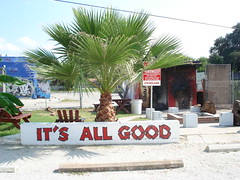
It's All Good
One of the teachers in my school was selling bracelets for her daughter (who has been ill) that says, "It's all good." I have been wearing it in support for her, but also because it reminds me that life is "all good" when things seems like they are about to spiral out of control (or when I am surrounded by negative thinking, which often happens behind the desk in my library -sigh!). I just read Bette's blog about how special Thanksgiving is, but especially, for her family, the day before Thanksgiving. It put me in a reflective mood...so here is my day before story...
Last night I was at La Guardia waiting for the moment when I would see my wonderful, tall, too-thin son , Adam, appear after a long day of traveling from Wisconsin, where he attends the University of Wisconsin. I hadn't seen him since the third week in August (except through one iChat). Finally, I spotted him walking down the ramp, looking like a typical college student - unshaven, messy hair, backpack and laptop. What joy to hug him hard. And I thought, that despite my worrying the past three months about his health and happiness, "It's all good." Later that night, the sound of deep male voices and laughter emanating from my kitchen as Adam's best friends raided my pantry while they caught up with each other about their lives at Columbia, Brown and Wesleyan (yes, he has smart friends) allowed me to go up to my bedroom, get under the covers, and think again, "It's all good."
Yesterday at school was insane. I scheduled all of my fourth and fifth grade research classes to meet with Noel Forte and me to make sure we were at the point we needed to be at in our various projects. There wasn't any time to stop and reflect on how wonderfully these students are doing - how engrossed they were as they went into their wikis, their blogs, their powerpoints, transforming and combining. As one of my classes sat in teams arguing (yes, very heated arguing) as they brainstormed ideas for a new U.S. holiday for our Federal Holidays project, I couldn't have been happier. In Adam Dugger's fourth grade class, we brainstormed questions to ask our Native American Project partner school in SC when we videoconference with them next week. Happy, happy, joy, joy. Collaboration, Synthesis and Constructivist Learning at its best with all four of my classes!
Yesterday was also a banner day for me with paychecks. It coincided that I received my paychecks from both of my jobs as well as from the Teacher Center for the Digital Storytelling Course I taught. Was I happy about the money? Of course, especially when my husband complained during the drive to LGA about the skyrocketing cost of heating oil. But, honestly, what really made me happy was what those checks represent - accomplishment. I am pulling it off - somehow - weaving all of this together, as Tim Gunn from Project Runway would say, I am "making it work." Bette talks about how layered our learning is, how we step into and out of different spaces. My life is like that. During the course of one day, I do step in and out of so many spaces, and I have to say that I love it. Although it is often exhausting, and I definitely do not get enough sleep, and I can't seem to get myself to stay on a diet (at some point I will step into that space and FOCUS), I can't envision my life in any other way. How boring it would be. How lucky I am. How lucky I was yesterday, to start my day with a random hug from a fourth grade (troubled) student and to end it with a powerful one from my son. As I said, it's all good. I am thankful.
Carry on! (Now, if only I could look like Heidi Klum).
Last night I was at La Guardia waiting for the moment when I would see my wonderful, tall, too-thin son , Adam, appear after a long day of traveling from Wisconsin, where he attends the University of Wisconsin. I hadn't seen him since the third week in August (except through one iChat). Finally, I spotted him walking down the ramp, looking like a typical college student - unshaven, messy hair, backpack and laptop. What joy to hug him hard. And I thought, that despite my worrying the past three months about his health and happiness, "It's all good." Later that night, the sound of deep male voices and laughter emanating from my kitchen as Adam's best friends raided my pantry while they caught up with each other about their lives at Columbia, Brown and Wesleyan (yes, he has smart friends) allowed me to go up to my bedroom, get under the covers, and think again, "It's all good."
Yesterday at school was insane. I scheduled all of my fourth and fifth grade research classes to meet with Noel Forte and me to make sure we were at the point we needed to be at in our various projects. There wasn't any time to stop and reflect on how wonderfully these students are doing - how engrossed they were as they went into their wikis, their blogs, their powerpoints, transforming and combining. As one of my classes sat in teams arguing (yes, very heated arguing) as they brainstormed ideas for a new U.S. holiday for our Federal Holidays project, I couldn't have been happier. In Adam Dugger's fourth grade class, we brainstormed questions to ask our Native American Project partner school in SC when we videoconference with them next week. Happy, happy, joy, joy. Collaboration, Synthesis and Constructivist Learning at its best with all four of my classes!
Yesterday was also a banner day for me with paychecks. It coincided that I received my paychecks from both of my jobs as well as from the Teacher Center for the Digital Storytelling Course I taught. Was I happy about the money? Of course, especially when my husband complained during the drive to LGA about the skyrocketing cost of heating oil. But, honestly, what really made me happy was what those checks represent - accomplishment. I am pulling it off - somehow - weaving all of this together, as Tim Gunn from Project Runway would say, I am "making it work." Bette talks about how layered our learning is, how we step into and out of different spaces. My life is like that. During the course of one day, I do step in and out of so many spaces, and I have to say that I love it. Although it is often exhausting, and I definitely do not get enough sleep, and I can't seem to get myself to stay on a diet (at some point I will step into that space and FOCUS), I can't envision my life in any other way. How boring it would be. How lucky I am. How lucky I was yesterday, to start my day with a random hug from a fourth grade (troubled) student and to end it with a powerful one from my son.
 As I said, it's all good. I am thankful.
Carry on! (Now, if only I could look like Heidi Klum).
Sunday, November 18, 2007
We the People Announces Bookshelf Grant
The National Endowment for the Humanities in cooperation with the American Library Association Public Programs Office is accepting applications for the fifth We the People Bookshelf program. Each year, NEH identifies a theme important to the nation’s heritage and selects books that embody that theme to build the We the People Bookshelf. The theme for the 2007-08 Bookshelf is “Created Equal.”
The “Created Equal” Bookshelf grants are part of the NEH's We the People initiative, which aims to encourage and strengthen the teaching, study, and understanding of American history and culture through libraries, schools, colleges, universities, and cultural institutions. Since 2003, NEH and ALA have awarded We the People Bookshelves to 6,000 public and school libraries. NEH plans to issue a We the People Bookshelf each year on themes related to American ideas and ideals.
The “Created Equal” Bookshelf grants are part of the NEH's We the People initiative, which aims to encourage and strengthen the teaching, study, and understanding of American history and culture through libraries, schools, colleges, universities, and cultural institutions. Since 2003, NEH and ALA have awarded We the People Bookshelves to 6,000 public and school libraries. NEH plans to issue a We the People Bookshelf each year on themes related to American ideas and ideals.
Sunday, November 11, 2007
Web 2.0 Overload?
When is it too much of a good thing? I have lately been feeling like I am on web 2.0 overload. I am blogging, wiki-ing; I use twitter, iChat, gmail chat, skype; I am a part of 4 'nings' now: Classroom 2.0; Teacherlibrarian 2.0; Information Fluency 2.0; NYSCATE 2.0, I have 5 different email addresses, I probably have hundreds of rss feed reads to catch up on and tons of podcasts to listen to. I have 7 billion passwords and user names. I am maintaining about 6 wikis, and overseeing 100 student blogs on blogmeister. Not to mention that I like to get in and read the 30 or so TEAM blogs on a weekly basis. (Oh, and by the way, I also teach 600 elementary students, 30 adult students, occasional teacher courses, have two kids in college and a husband, a dog, and a house to give attention to.)
So how can I possibly keep up with all of these forums of communication????
There is going to come a time when I will have to pick and choose my way through all of these new web 2.0 tools. There are times that I JUST DON'T CARE what other people are doing!! There are times that I have to tell myself to close my laptop - that there is a fine line between wanting to be part of and contribute to this great information network and letting it take over my life!
Do you ever feel that way?
I also think that I have to keep in mind when I read some of the wonderful blogs and interesting 'tweets' of some of my favorite thinkers that for a few of them, this is what they do for a living, and that there are not enough hours in the day for me to blog/twitter/wiki/network at the pace that they do! On the other hand, so many of them have 'day jobs' like I do and yet find the time to think great thoughts and share them with the rest of us. Of course, when I read one of these great insights, my mind starts going, the emails, blogs and wikis get opened, and I'm sucked right back into the thick of it.
I have noticed, however, that one thing for me has gone by the wayside as a result of the availability and immediacy of web 2.0 information - that is, I have basically stopped reading my teacher/library magazines. One, I don't have time and two, by the time it comes to me it's old news or I have read the online version. That worries me a little...
So how can I possibly keep up with all of these forums of communication????
There is going to come a time when I will have to pick and choose my way through all of these new web 2.0 tools. There are times that I JUST DON'T CARE what other people are doing!! There are times that I have to tell myself to close my laptop - that there is a fine line between wanting to be part of and contribute to this great information network and letting it take over my life!
Do you ever feel that way?
I also think that I have to keep in mind when I read some of the wonderful blogs and interesting 'tweets' of some of my favorite thinkers that for a few of them, this is what they do for a living, and that there are not enough hours in the day for me to blog/twitter/wiki/network at the pace that they do! On the other hand, so many of them have 'day jobs' like I do and yet find the time to think great thoughts and share them with the rest of us. Of course, when I read one of these great insights, my mind starts going, the emails, blogs and wikis get opened, and I'm sucked right back into the thick of it.
I have noticed, however, that one thing for me has gone by the wayside as a result of the availability and immediacy of web 2.0 information - that is, I have basically stopped reading my teacher/library magazines. One, I don't have time and two, by the time it comes to me it's old news or I have read the online version. That worries me a little...
Saturday, November 10, 2007
Monday, November 5, 2007
Constructivism in the Library

TEAM students are working through the constructivism module and blogging about it in their blogs. It reminded me of my own study of this subject when I was a TEAM student a few years ago. The image above was made in Fireworks and it is featured on my Educational Philosophy web page. Reading other students' blogs motivated me to go back and read what I wrote and to think about how I might add to it to incorporate web 2.0, the technological landscape that has emerged since I graduated. Here is what I wrote in 2002:
As schools explore the potential of information and electronic technologies, it has become clear that the 21st century library/educational technology specialist has the responsibility to ensure that students and teachers are effective and critical users of information. At the heart of the American Association of School Librarians' Information Power is a constructivist pedagogical framework. Team building, shared inquiry, project based learning, performance assessment, technology integration, learning communities, critical thinking and viewing, emotional intelligence, and multiple intelligences are the vessels that supply the lifeblood to knowledge construction.
Thoughts on Constructivism and Technology Integration in the Library Media Center:
Meaning making is at the heart of the constructivist philosophy of learning and at the heart of Information Power, the framework for the American Association of School Librarians' Information Literacy Standards. Meaning making is prompted by a problem, question, confusion, disagreement, or dissonance (a need or desire to know) and so involves personal ownership of that problem. In the constructivist model, knowledge is constructed, emergent, situation in action or experience, and distributed. (Jonassen et al,1999). Thus, each person must build or construct a framework of knowledge based on what they already know. Traditionally, teachers were the sage on the stage. In the past, this prepared students for the assembly lines of the Industrial Age. Today, however, students must be encouraged to construct meaning from a myriad of information available to them in the Information Age.
Technology brings into the library more interesting and diverse materials than ever thought possible. Hundreds of libraries and museums, including the Library of Congress and the Smithsonion, distribute their resources in digital form. Technology can expand students' horizons with online field trips to historic sites and to museums to study art and artifacts. They can follow expeditions, engage in simulations, and gather environmental data to share with other students. Library Media Specialists who guide their students to learn in these new ways prepare them for lifelong learning. ("Web-Based Learning," Gwen Solomon and Lynne Schrum, Education Week, May 29, 2002).
The constructivist library media specialist sets up problems and monitors student exploration, guides the direction of student inquiry and promotes new patterns of thinking. Constructivist teachers refer to raw data, primary sources, and interactive materials to provide experiences for their students rather than relying solely on another's set of data. (Classroom Compass, SEDL-SCIMA,1994) Students cannot ask a textbook, "What is it like to rescue a stranded whale?" Yet, this is the type of real-world question that can be asked when technology is used as a partner to foster learning.
How Technologies Foster Learning and Support Knowledge Construction
Technologies in the library media center can be used as vehicles for:
- representing learners' ideas, understandings, and beliefs
- producing organized, multimedia knowledge bases by learners
- accessing needed information
- comparing perspectives, beliefs, and world views
- representing beliefs, perspectives, arguments, and stories of others
- collaborating with others
- building consensus among members of a community
- helping learners articulate and represent what they know
- reflecting on what they have learned
- constructing personal representations of meaning
Adapted from Learning With Technology: A Constructivist Perspective by David H. Jonassen, Kyle Peck and Brent G. Wilson (Upper Saddle River, NJ: Prentice Hall, 1999)
In a Constructivist Library Media Center:
- Student autonomy and initiative are accepted and encouraged.
- Higher-level thinking is encouraged. Students are encouraged to connect and summarize concepts by analyzing, predicting, justifying, and defending their ideas.
- Students are engaged in dialogue with the teacher and with each other. Social discourse helps students change or reinforce their ideas. If they have the chance to present what they think and hear others' ideas, students can build a personal knowledge base that they understand. The class uses raw data, primary sources, manipulatives, physical, and interactive materials.
- The constructivist approach involves students in real-world possibilities, then helps them generate the abstractions that bind phenomena together.
Adapted from In Search of Understanding: The Case for Constructivist Classrooms by Jacqueline G. Brooks and Martin G. Brooks (Alexandria, VA: Association for Supervision and Curriculum Development, 1993)
Thoughts on Team Building: The Library As A Learning Organization
Learning organizations are where people continually expand their capacity to create the results they truly desire, where new and expansive patterns of thinking are nurtured, where collective aspiration is set free, and where people are continually learning to see the whole together. For this to happen, it is argued, organizations need to "discover how to tap people's commitment and capacity to learn al all levels." (Senge 1990).
The goals of today’s library media program point to the development of a community of learners that is centered on the student and sustained by a creative, energetic library media program. Team Building occurs in the library when:
- there are learning experiences that encourage students and others to become discriminating consumers and skilled creators of information through comprehensive instruction related to the full range of communications media and technology
- the library media specialist provides leadership, collaboration, and assistance to teachers and others in applying principles of instructional design to the use of instructional and information technology for learning
- the library media specialist provides resources and activities that contribute to lifelong learning while accommodating a wide range of differences in teaching and learning styles, methods, interests, and capacities
- the program functions as the information center of the school, both through offering a locus for integrated and interdisciplinary learning activities within the school and through offering access to a full range of information for learning beyond this locus
- the library program provides resources and activities for learning that represent a diversity of experiences, opinions, and social and cultural perspectives.
Adapted from: Information Power: Building Partnerships for Learning (AASL, 1998)
Thus, the framework of the library learning community in which students and teachers function needs to be conducive to reflection and engagement. In The Fifth Discipline, Peter Senge tells us that "real learning gets to the heart of what it is to be human...for a learning organization, 'adaptive learning' must be joined by 'generative learning', learning that enhances our capacity to create." (Senge 1990). Most importantly, learning in the library is a lifelong discipline, a process, in which members of the learning community access, share, contribute, and build information as a team.
Shared Inquiry: The Underlying Foundation
The library media specialist provides intellectual access to information through learning activities that are integrated into the curriculum and that help all students achieve information literacy by developing effective cognitive strategies for selecting, retrieving, analyzing, evaluating, synthesizing, creating, and communicating information in all formats and in all content areas of the curriculum. (Information Power: Building Partnerships for Learning 1998).
Howard Gardner On the Importance of Engaging Students Actively in What They are Studying:
We have schools because we hope that some day when children have left schools that they will still be able to use what it is that they've learned. And there is now a massive amount of evidence from all realms of science that unless individuals take a very active role in what it is that they're studying, unless they learn to ask questions, to do things hands on, to essentially recreate things in their own mind and transform them as is needed, the ideas just disappear. The student may have a good grade on the exam, we may think that he or she is learning, but a year or two later there's nothing left.
Inquiry-based activities cause students to revise their prior understandings and deepen their understandings of the world. Inquiry is a dynamic approach to learning that involves exploring the world, asking questions, making discoveries in the search for new understandings. In an inquiry-based library program, students develop skills such as careful observation, reasoning, critical thinking, and the ability to justify or refute their existing knowledge. Because inquiry begins with a meaningful problem or issue, the process engages students as they come to value the essential question that motivates the inquiry process.
Shared inquiry lends itself to collaborative activities. The collaborations are multidimensional in that students collaborate with each other, with teachers, as they learn alongside with students, and with experts provided by technological access in the library. Project-based learning is a vehicle for students to work in teams, apply what they know, problem-solve, self-direct their learning as they explore real-world problems and tasks. Student learning is gauged through performance assessment, the essential companion to project-based learning.
Critical thinking is directly related to inquiry-based activities. Students are bombarded with electronic, visual information and it is crucial to give them the skills to question what they see; to distinguish between information and info-garbage; to determine the credibility of their sources and to identify and recognize logical fallacies.
Putting It All Together: Building the Learning Community
Team building, collaboration, constructivism, shared inquiry, critical thinking, project-based learning, performance assessment, multiple and emotional intelligences, coupled with the use of information and communication technologies, provide an environment where all members of the community come together to construct knowledge. It is my philosophy to create a learning library in which both educators and students have the opportunity to stay in a continual learning mode as they work in a collegial environment which provides pedagogical, technological, and emotional support. The integration of technology into the library allows connections to be established between communities inside and outside the walls of the library. In this environment, learning is an evolving process where all members of the learning community have the opportunity to learn side by side.
Resources:
Bibliography:
Brooks, Jacqueline G. and Martin G. Brooks. In Search of Understanding: The Case for Constructivist Classrooms. Alexandria, VA: Association for Supervision and Curriculum Development, 1993.
Jonassen, David H., Kyle Peck and Brent G. Wilson. Learning With Technology: A Constructivist Perspective. Upper Saddle River, NJ: Prentice Hall, 1999.
Senge, Peter. The Fifth Discipline: The Art and Practice of the Learning Organization. NY: Currency/Doubleday, 1994.
Solomon, Gwen and Lynne Schrum. "Web-Based Learning." Education Week 29 May 2002: 48.
Webliography:
American Library Association and Association for Educational Communications and Technology. "Information Power: Mission and Goals of the School Library Program" [Online] Available June 16, 2002.
Lucas, George. "Edutopia" [Online] Available June 16, 2002.
Murphy, Elizabeth. "Constructivism: From Philosophy to Practice" [Online] Available June 16, 2002.
Southwest Educational Development Laboratory."Constructing Knowledge in the Classroom." Classroom Compass Winter 1994, Vol. 1, No. 3. [Online] Available June 16, 2002.
Further Browsing:
Advanced Readings for Critical Thinking Workshop
Comer School Development Program
Constructivism
 I guess what I would add to that now is that web 2.0 mandates a new kind of literacy because the web has become so interactive. Information literacy skills are more critical than ever, and the AASL has recognized this and has just unveiled the revised information literacy standards at the recent AASL Conference in Reno to reflect this. (New Learning Standards). The exponential growth of information on the net and the ability to easily be an information contributor goes hand in hand with constructivist learning. The importance of being an ethical, critical, and creative user of the net cannot be overstressed. And this is why I love what I do! What a great time to have my job!
On a completely different note, my 22-year-old daughter was looking at my blog and said that the frappr map on my blog is "creepy"...hmmm.
Subscribe to:
Posts (Atom)